Narrative focuses on the way the story is revealed to the audience, the order of the occurring events and how the information is portrayed to us.
Stories are the events in the order of their occurrence, where as the plot is the order in which they are told to the audience. Narratives are about the structure of the text, it is about how it is told.
Types of narratives:
Linear narrative- this has a start, a middle and end, the shots are in chronological order.
Restricted narrative- This is narrative from only one character in the story, the audience has limited access to narrative events as they only see events at the same time the character does.
Omniscient narrative- Narrative from more than one character so that the audience has access to more narrative events, sometimes knowing more than the characters.
Todorov

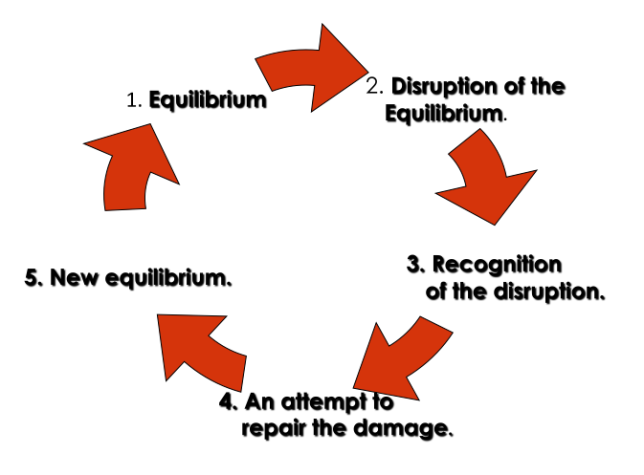
Todorovs describes the structure of events with a narrative:
Equilibrium- this sets the scene of everyday life, this establishes what life is like for the main characters before anything happens to them.
Disruption- Something happens which effects the equilibrium with a series of events.
Recognition of disruption- This is the climax of the film, the characters realize a disruption has occurred.
Repair of disruption- The characters struggle to repair the disruption and return back to the equilibrium.
New equilibrium- Peace is restored, but not usually the same, may be better than the original equilibrium.
 Mckee's 'classical narrative structure'
Mckee's narrative structure is different to Todorovs...
Exposition- This introduces the main characters of the film, mostly the protagonist, their everyday lives and locationAgents of change- Something occurs which changes their lives, normally affected by the antagonist.Conflict complication- The characters try to resolve the problem but it cannot be easily resolved.
Elaboration- This is the main part of the film, the key plot is denoted to the audience.
Climax & Resolution- The resolution doesn't necessarily mean everything is back to normal, this is the climatic moment of the film.
Coda- This sets the film up for a sequel, it sets up a question for the audience who think it's resolved but not fully. This is not commonly found in British Social Realism's.
What decisions did you make about the content of your BSR treatment?
We decided to introduce our opening with a smash mouth to intrigue our audience straight away, this will introduce the characters of the film and locations without fully exposing the themes. It will be non linear as it will include flashbacks of the party, the rest of the film is linear. Our narrative will be omniscient so that the audience has access to things that Becca, the main protagonist does not.
A shooting script breaks down the production into separate shots, it includes the dialogue, shot type and angle, duration, shot movement, music/sound effects, lighting, description of action, equipment, actors and shot number. This helps the director to have a clear understanding and easily film exactly how it was planned just by reading it.
Here is an example:

From reading a previous group's shooting script I have learnt that it is very difficult to film when the script is not as clear as it could be, it was quite confusing to read as the actors were muddled up, there was not always clear instructions for me as a director to direct my group clearly with. I have also learnt that before filming it is best to read through the whole shooting script and not to read as we film as it becomes confusing.
The strengths of our work were that we kept to the 180 degree rule at all times, we made sure that our male actor was always on the left of the shot. Our camera shots and angles were varied and we stuck to the shots stated in the script at all times using close ups, mid shots, long shots, and extreme close ups.
Our weaknesses were firstly that we did not manage to finish filming, we were only given a short period of time and the actors did not stay in character so our film did not look as professional as it could have. Our group experienced some confusion in the characters, we did not clearly understand that there was 4 characters not 3 until towards the end of filming.

No comments:
Post a Comment